The 72-Hour Rule: Why Your Store-Bought ‘Fresh’ Juice Is Nutritionally Inferior
Fresh juice is at its nutritional peak the moment it’s made. From there, the vitamins and antioxidants begin to break down, even under perfect refrigeration.
That’s why most raw, unpasteurized juice keeps its best quality for about 72 hours.
So when you see “fresh” juice sitting on a store shelf or behind a juice counter for days, remember this: it may still taste good, but it’s no longer at its full nutritional strength.
Even bottled cold-pressed juices have limitations.
Yes, many reputable brands use HPP (High Pressure Processing) to extend shelf life without preservatives. And while this keeps the juice safe and clean, it still can’t stop natural nutrient loss over time.
That’s why nothing compares to drinking juice the moment it’s extracted.
Homemade cold-pressed juice delivers the highest levels of enzymes, antioxidants, and vitamins in a way no store-bought product can match.
And I’ll go over the science behind it.
Why Store-Bought “Fresh” Juice Is Nutritionally Inferior
As I just explained, store-bought, packaged juices don’t offer the same level of nutrition as fresh, cold-pressed juices do.
And the difference in nutrition comes from the very production methods.
Most regular juices that you find in the juice aisles in grocery or super stores are made with industrial extractors that may contain high-speed blades that create heat. That heat plus oxidation destroys some of the vitamins and antioxidants that are heat-sensitive.
Here’s the problem.
Many people get store-bought juices because they think they’ll get more vitamins and minerals. But if the production methods aren’t good enough, you won’t get maximum levels of those micronutrients. For example, vitamin C, a highly coveted vitamin especially in the cold season, is highly heat-sensitive, so it can degrade fast.
Then, there’s pasteurization, which further exacerbates heat-sensitive nutrient loss. When juice is heated to kill bacteria and other pathogens and extend shelf life, the trade-off is vitamins like A and C and enzymes.
You obviously want your juice to have maximum concentration of nutrients. But that’s not the case with most store-bought juices.
High-pressure processing (HPP) is not perfect, either.
In this preservation process, high pressure is used instead of heat to kill germs.
And yes, the lack of heat leads to better nutrient preservation. However, it can change protein structure, and degradation can still happen in storage.
Even with this better processing method, the juice will lose freshness after a few days because enzyme activity reduces antioxidant availability over time (that’s a concern raised in one research study).
And let’s not forget the sugar problem.
Any store-bought juices with added sugar (regular or artificial) aren’t too healthy. Juices are already concentrated in natural sugars, and adding any more of them spikes your glucose levels.
The 72-Hour Nutrient Decline Window
Ideally, you should drink your juice straight out of the glass when it’s produced. The freshness and taste are at their peak. But more importantly, the nutrients are all intact. You could refrigerate it in an air-tight container to preserve it for up to 72 hours, but know that nutrient loss has already begun.
Right after you juice, vitamin C, polyphenols, and native enzymes are at their peak, and then they start quietly slipping away.
Research proves this.
For example, a 2022 study on commercial orange juices found about 37.8% loss of vitamin C after just 24 hours in the fridge. And this was regardless of the production method.
Another experiment on vegetable juices stored at 4°C showed 0.65–21.7% vitamin C loss in the first 24 hours, depending on the vegetable and packaging, with higher losses at room temperature. Also, it showed plastic containers had a shorter shelf life for vitamin C.
And last I checked, most store-bought juices were packed in plastic bottles.
Polyphenols are a bit more complex. Some are quite stable, others (like certain flavanols) oxidize quickly, especially when oxygen and polyphenol oxidase (PPO) enzymes are active.
Juice enzymes (like pectin methylesterase, peroxidase, and PPO) usually remain active for many hours unless they’ve been inactivated by heat, high pressure, or other processing.
That means that, hour by hour, these enzymes slowly break down pectin (affecting cloud and texture) and drive oxidation reactions that consume polyphenols and subtly change flavor and color.
The Cold-Pressed Lie: Not All Cold-Pressed Juice Is Fresh
Ok, so we know that regular juice isn’t the best option on the table. But what about cold-pressed juice sold in stores? You know those small bottles in your local high-end grocery store that retail for upwards of $15 a piece.
Well, they’re not as fresh as you’d think.
They do have a shorter shelf life than regular packaged juice. However, they still may be stabilized to last for anywhere from a couple of days to a whole month.
And as I explained earlier, juices continue to lose nutrients in storage (especially at room temperature), even with HPP.
Some of these so-called cold-pressed juices may even contain preservatives. Unlike the juice you make at home with your juicer, these juices are produced commercially at scale. And they’re made in factories in one place and shipped out nationwide in some cases.
You can put two and two together. Preservatives are likely used in many of these situations.
I’m not saying preservatives are all bad. However, if a juice is made in a factory, has preservatives and stabilizers, travels a distance for days, and sits in stores for a few more, I wouldn’t call it “fresh.”
And I’ve learned all that the hard way. It wasn’t until a very real health scare that I got into juicing and really understood the health trade-off we make by choosing the convenience of store-bought juice when, by the way, making juice at home is super easy and affordable.
Why Homemade Cold-Pressed Juice Beats Any Store-Bought Bottle
Here’s my advice: if nutrition is your goal with juicing, choose homemade, choose cold-pressed, and choose fresh. That’s far better than anything you’d find in stores.
Why?
Zero heat: Slow juicers don’t produce any heat like centrifugal juicers.
Zero preservatives and processing: There are no additives whatsoever, and no heat or pressure treatments.
Zero shelf time extension: No stabilizers to extend shelf life.
Highest bioavailability: You get the highest concentration of micronutrients and enzymes ready to be absorbed by your body.
Cold-pressed juice is already much better than regular store-bought juice. But when you make it at home, you get the best possible product.
How to Make Ultra-Fresh Juice at Home Even If You’re Busy
What discourages many folks from juicing at home and leads them to buying from stores is the ‘lack of time.’
I get it, you’re busy.
But with the right juicer, even busy individuals can juice at home and tap the health benefits (and awesome taste) of fresh, cold-pressed juice.
First, you need a juicer that requires little to no prep: one that is large enough to fit whole fruits. You also want a juicer that’s easy to wash, so the cleanup is quick.
And that’s exactly what you get with Hurom.
Hurom’s juicers, like the H400 and H70 Easy Clean Slow Juicers, feature large hoppers that easily accommodate whole ingredients (without any peeling or chopping in many cases). Plus, they’re super quick and easy to clean. Just take apart the juicer and rinse the washable parts under running water.
Cold-pressed juices give you an easy way to add more fresh produce to your diet. And you can get a wide range of health benefits through maximum vitamin and antioxidant retention.
In fact, our juicers use the patented Slow Squeeze Technology, that mimics hand squeezing. This juicing method keeps your nutrients intact instead of damaging them.
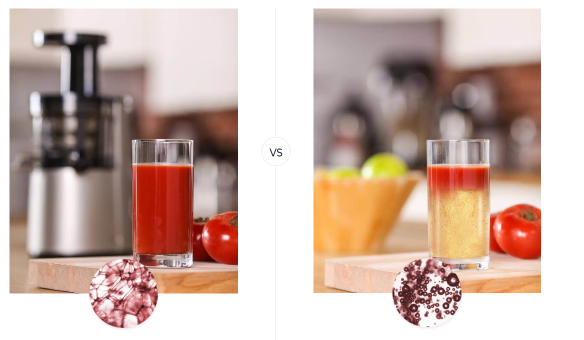
Here’s a close-up of a juice made with Hurom versus with a regular centrifugal juicer, with fast-spinning blades that produce heat:
Besides, Hurom juicers have a 15-year warranty.
Now imagine you’re buying “fresh” store juice every day instead.
Let’s be generous and say a bottled cold-pressed juice costs $6. Over a year, that’s about $2,190 just on juice.
With a Hurom, you do have to buy fruits and veggies, but the numbers still work in your favor. A simple juice made from one apple, one cucumber, one carrot, and a handful of greens comes out to roughly $2.50 worth of produce. Even if we add about 10 cents per glass to “pay off” your Hurom over 15 years, your homemade juice still lands around $2.60 per day.
So:
Store-bought: $6/day or ~$2,190/year
Hurom at home: ~$2.60/day or ~$950/year
In other words, you’re saving around $1,200 every single year, and you’ve paid back the cost of a $500 Hurom in about 5 months.
After that, it’s pure savings, plus fresher juice with higher nutrient retention.
Try fresh cold-press juice for 7 days and feel the difference!
FAQ
How do I know if a juice has lost its nutrients already?
Juice has likely lost its nutrients if it smells sour, tastes off, or has changed color. Nutrient loss increases after 24–48 hours, especially if exposed to light, heat, or air. Vitamin C and antioxidants degrade fastest.
What’s the difference between HPP and pasteurization for nutrient retention?
The main difference between HPP and pasteurization is how they preserve nutrients. HPP uses cold pressure, which retains more vitamins and enzymes. Pasteurization uses heat, which destroys some nutrients.
Is it safe to drink juice after 24-48 hours?
It is generally safe to drink juice within 24–48 hours if refrigerated, but nutrient levels drop significantly. After 48 hours, spoilage risk increases, especially for unpasteurized juice. Always check smell, taste, and color before drinking.
Which fruits and veggies stay fresh the longest after juicing?
Carrots, beets, apples, and celery stay fresh the longest after juicing due to low oxidation rates. These ingredients retain taste and color for up to 72 hours when refrigerated in airtight containers.
Do slow juicers really make juice last longer?
Yes, slow juicers make juice last longer by reducing oxidation. They operate at low speeds, preserving enzymes and nutrients. Juice from slow juicers can stay fresh for up to 72 hours when stored properly.
How much money can I save by juicing at home instead of buying bottled?
Juicing at home can save you $3 to $6 per 16-oz serving compared to bottled juice. Over a month, this adds up to $90–$180 for daily drinkers. Savings depend on produce prices and the frequency of juicing.